




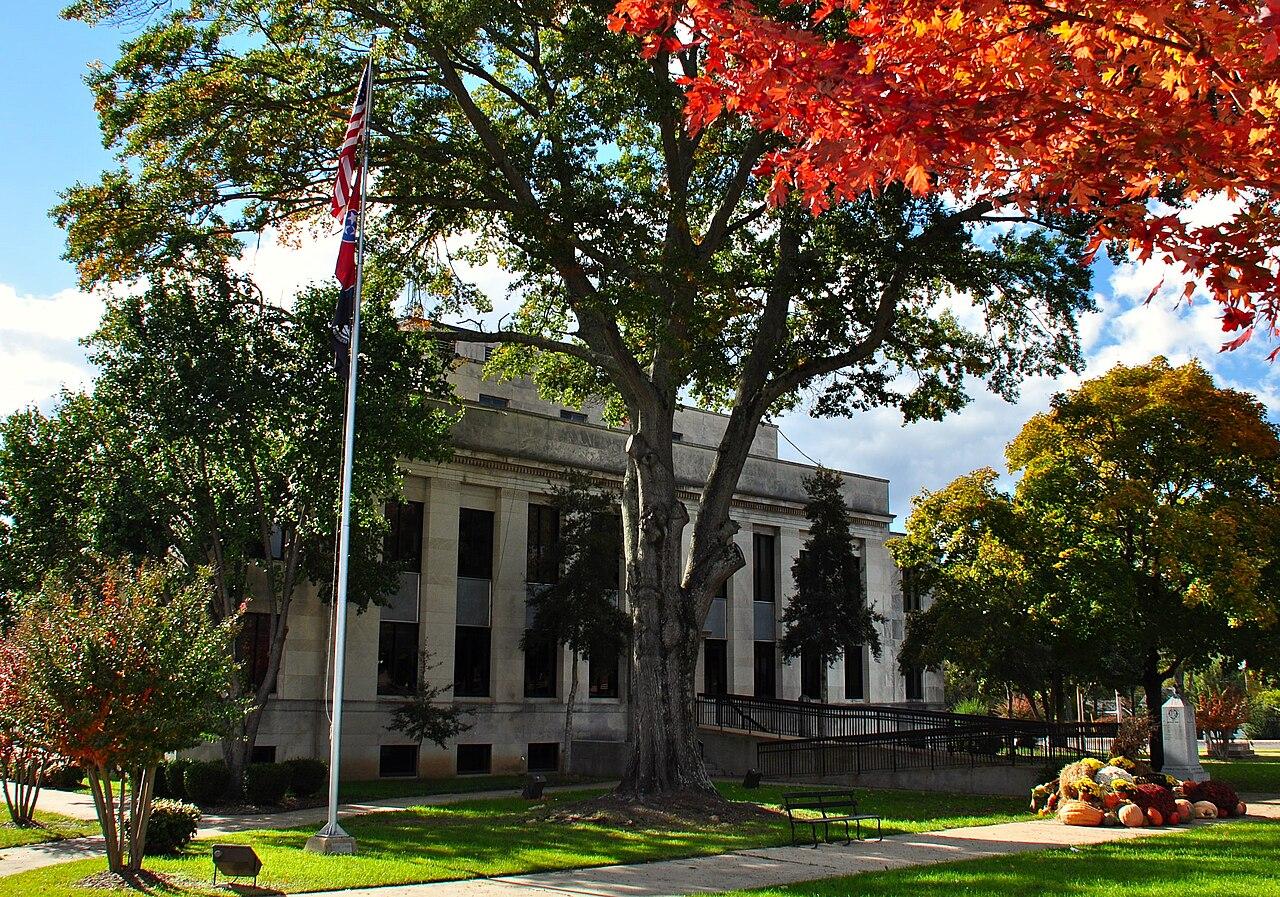


No one made a conscious decision to designate McNairy County, Tennessee, the center of the Buford Pusser universe—at least not in the beginning. There were no focus groups or public meetings to build consensus. No one weighed the options or calculated the long-term costs of promoting the region as the birthplace and home of Sheriff Pusser’s audacious exploits.
Neither did the Pusser identity happen by accident. A lawman with a flair for the dramatic, the irresistible gravitational pull of national media exposure, and a starstruck public aligned to determine an outsized portion of the county’s image for more than half a century. For better or worse, if they think about McNairy County at all, non-locals are still likely to connect it with Walking Tall and the legend of Buford Pusser.
Now, however, the famous sheriff is credibly accused of murdering his wife and fabricating an elaborate story to cover up his crime – a fiction that substantially informed the legend that made Buford Pusser a national hero. Needless to say, many in the neighborhood are rethinking what it means to leave community identity to random chance, or allow it to be crafted by myth-makers and Hollywood screenwriters.
A Murky Backstory
Buford Pusser was narrowly elected McNairy County Sheriff in 1964 on a promise to clean up illegal bootlegging and organized crime along the notoriously seedy Tennessee-Mississippi State Line. During three two-year terms in office, Pusser’s high-profile busts grabbed headlines across the region, but it was the supposed ambush of 1967 that made him a national figure.
Pusser reportedly took his wife along on an early morning police call when unknown assailants surprised them on a rural backroad, leaving Pauline Pusser dead and the Sheriff gravely wounded. He blamed State Line enemies, but investigators were suspicious of Pusser’s ambush story from the outset. Unable—some say unwilling—to make a case against a fellow officer, the investigation stalled, leaving the murder of Pauline Pusser unsolved for decades.
With the case going cold and much of the public taking Pusser’s ambush story at face value, a sensationalistic biography, a series of country music ballads, and the lurid Walking Tall movie franchise followed in rapid succession. The death of Pauline Pusser quickly became the centerpiece and defining element of Pusser’s story, engendering sympathy and catapulting the lawman to national prominence. The media couldn’t get enough of the flesh-and-blood hero behind the extraordinary stories and songs. With a box-office hit on their hands, Bing Crosby Productions went as far as signing Pusser to play himself in Walking Tall Part 2. But it was not to be.
Building Identity on Pusser’s Legacy
A high-speed car crash took Buford Pusser’s life in 1974 at the crest of his popularity. In a single decade, he had gone from unknown, small-town lawman to national celebrity. If anything, the poignancy and tragic circumstances of his death sparked more interest in the Sheriff’s life and career, significantly enlarging the legend. It’s an epic tale that a community can wrap its arms around.
The Buford Pusser Home and Museum was established to preserve his legacy. A memorial was erected at the site of the fatal car crash. Tours taking in Walking Tall film locations, along with the actual sites of Pusser’s exploits, sprang up in the region. Pusser’s name and image were emblazoned on welcome signs, water towers, and visitor brochures. Highways and byways were renamed in his honor, while the Sherrif’s office and jail in the McNairy County Courthouse were roped off and restored to allow visitors a behind-the-scenes look at the nerve center of the Pusser’s law enforcement operations.
Through the last decades of the 20th Century, well into the 21st, Adamsville and McNairy County, Tennessee, were synonymous with the legend of Buford Pusser. The annual festival drew thousands of fans, while the intentional investment in visitor infrastructure put heads in hotel beds and dollars in Main Street cash registers. Tourism advocates enthusiastically touted the economic benefits, but now, some are wondering at what cost? Obviously, recent revelations make the Pusser story significantly more complicated for locals.
Complicated may be an understatement. The Pusser legend has always attracted a cult following that trades in vigilante justice and noble cause corruption fantasies. As the theory goes, the ruthlessness of bad guys sometimes necessitates the lawlessness of the good guys; the end justifies the means. Something along those lines informed the Pusser mythos from the beginning. That’s confirmed by the decision to recognize controversial law enforcement figures like Sheriff Joe Arpaio and Sheriff David Clarke at the annual Buford Pusser Festival.
To be fair, many honorable officers have received The Buford Pusser National Law Enforcement Award since its inception in the late 1980s, but men like Arpaio and Clarke were presumedly selected—at least in part—because organizers felt they were modern-day exemplars of Pusser’s approach to law enforcement. If that’s true, it does nothing to tamp down criticism of a local identity that aligns with abuse of authority, racial profiling, and police brutality. Combined with Pusser’s suspected involvement in domestic violence and now murder, this is hardly a recipe for a business-friendly atmosphere, let alone an attractive welcome mat for visitors.
A far better look for the region is the Tennessee Law Enforcement Memorial. Dedicated last year, the memorial, on the grounds of the McNairy County justice complex, lists the names of Tennessee officers who died in the line of duty. There’s nothing splashy or sensational about it, the tasteful stone wall stands as a solemn reminder of the steep price of public safety. Current McNairy County Sheriff Guy Buck hasn’t received enough credit for organizing and overseeing the nonprofit foundation that erected and sustains the memorial. It’s a fitting course correction for a county facing the sobering reality of embracing fabricated folk hero narratives.
The Lessons
But the lessons here go far beyond how one county handles public relations. It’s no secret that a loss of meaningful identity sometimes plagues rural places, especially small towns experiencing economic disinvestment or a breakdown in traditional community structures and social systems. Under such conditions, it’s natural to grasp at shiny objects, but there are no shortcuts when it comes to understanding the unique character of each place and responsibly deploying such knowledge to the benefit of a community.
Local identity involves more than an aggressive marketing campaign. Residents should have a voice in how their hometowns are depicted to the world, and that involves the hard work of consensus-building. Self-determination can evolve organically, but too often a handful of people with narrow agendas wind up in the driver’s seat, as with those who decide that Buford Pusser was the only thing worth talking about in McNairy County. It’s always been the case that communities can come together to decide issues of identity, or someone else will decide for them.
Fortunately, a community is never just one thing. Simple, do-it-yourself asset mapping involving a broad coalition of local stakeholders is apt to turn up a long list of placemaking gems that already engender pride among residents. Each community has a unique flavor, which can be the basis of more nuanced narratives that reflect authentic local character with the consent of those who call that place home. That approach is simultaneously more satisfying, more sustainable, and more attractive to visitors.
What’s Next?
The first public meetings soliciting public input about the Pusser identity were held last fall, in the wake of bad news about the hometown legend. Predictably, local opinions ranged from doubling down on the Walking Tall mythology to integrating more of Pauline Pusser’s story in future presentations, or cutting the losses and moving on.
Some felt that Pusser’s shelf-life as a public figure had long since expired, while others sensed a revival of public interest in his career. A more cynical, rubber-necking view asserts that a villain is as good as a hero—maybe better—where attracting public attention is concerned, which reminds me of nothing more than a remark I made at a creative placemaking conference several years ago.
I won’t repeat it here, but I attracted more than a little vitriol for simply making the point that the tourism industry isn’t always choosy about what it promotes, while communities could and should be the stewards of their own identity. The take-home message was that an authentic sense of place, determined by residents, should always take precedence over strategies aimed at bringing more tourists to town. It’s no secret that tourism trends rise and fall on the whims of a fickle public.
A smart community asks itself if it can live with the public image it embraces when the tourists have come and gone.